Realistic Weapon Jams & Recoil for FiveM RP Servers (2026 Guide)
Guides · 5 min read · Published: 2026-08-05 · Updated: 2026-08-05
Fire a rifle in vanilla GTA V and nothing happens to your aim. No climb, no jitter, no reason to ever let go of the trigger. That's fine for a heist shootout in singleplayer. On a roleplay server where gunfights are supposed to carry weight, it's a problem. Players full-auto everything because there's no cost to doing it, and firefights turn into a race to see who clicks first rather than who aimed better.
Weapon jam and recoil scripts exist to fix exactly that gap. They're two separate mechanics that usually ship together because they solve the same underlying issue: gunplay with no friction doesn't feel dangerous, and gunplay that doesn't feel dangerous doesn't produce good roleplay.
What these systems actually change
Recoil systems apply per-weapon movement to your aim after each shot, tuned by weapon class. A pistol kicks a little and settles fast. A rifle on full auto climbs steadily the longer you hold the trigger, forcing you to reset your aim or burst-fire instead of spraying. Heavy weapons punish players who don't brace or aim down sights. None of this is exotic; it's the same idea most competitive shooters have used for years, adapted to GTA's animation system.
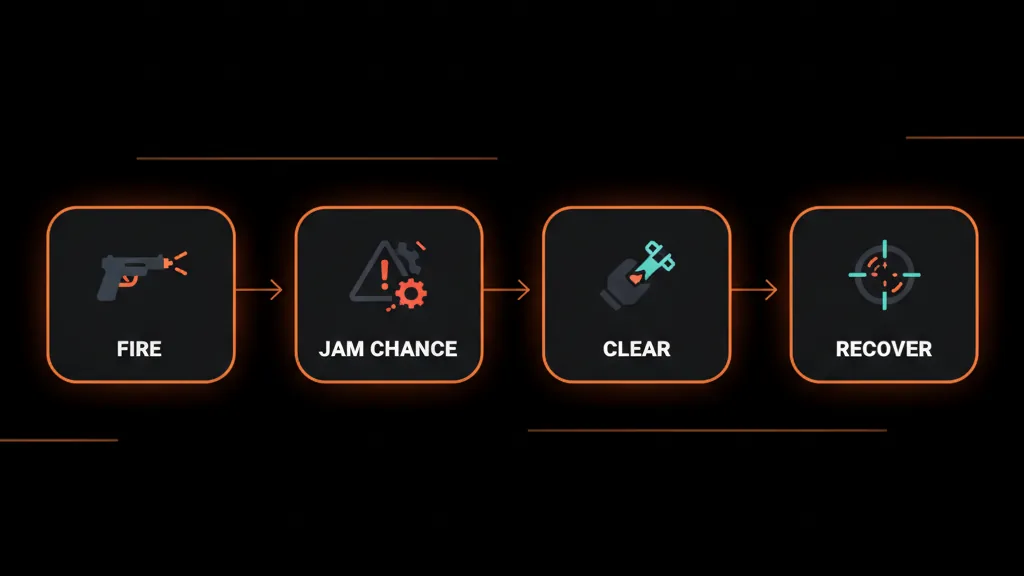
Jam systems add a separate failure condition: under configurable circumstances (dirty weapon, low maintenance, random chance scaled by weapon condition), a gun can jam mid-fight. Clearing it usually means a short animation, sometimes an item or tool, during which the player is exposed. That exposure is the entire point. A jam that clears itself is a wasted mechanic; a jam that costs you three seconds standing in the open changes how you approach a firefight.
Why this matters more on RP servers than anywhere else
On a deathmatch server, mechanics like this would just be an annoyance. On a roleplay server, combat is supposed to be a story, not a twitch contest. A jam at the wrong moment gives a scene somewhere to go: a standoff, a retreat, a partner covering while you clear your weapon. Recoil that actually matters means characters who've trained with a weapon behave differently from ones who haven't, which is the kind of detail RP communities notice and reward.
This is also why these systems tend to get adopted first by military RP and law enforcement RP servers, where gunfights happen constantly instead of being a rare event. If your server runs regular PD vs. crew shootouts, weightless gunplay is probably costing you more roleplay quality than almost anything else you could fix.
What to check before you install one
- Per-weapon tuning: pistols, SMGs, rifles, and heavy weapons need different recoil curves and jam rates. A script that applies one flat setting to every weapon will feel wrong on at least half your arsenal.
- Resmon cost: a weapon system runs constantly during combat, which is exactly when your server is under the most load from everything else. Check resmon (F8 → resmon 1) during a live firefight, not just at idle. Anything sitting above 0.05ms per tick during combat is worth a second look.
- Framework compatibility: confirm it supports your actual setup, whether that's ESX, QBCore, QBox, or standalone, before you buy anything.
- Player-facing configurability: servers vary wildly in how punishing they want combat to feel. A system with server-side tuning for jam frequency and recoil intensity is worth more than one that ships with a single hardcoded feel.
- Clear feedback: players need to know when they've jammed and what to do about it. A jam with no animation or indicator just looks like a bug.
See Revo GunJam & Recoil in action
Where servers get this wrong
The most common mistake is tuning jam frequency too high. A weapon that jams every few shots stops feeling like realism and starts feeling like the server is fighting the player. Jams should be rare enough that clearing one is a genuine "oh no" moment, not a routine part of firing your gun.
The second mistake is recoil that's punishing without being learnable. Good recoil patterns are consistent: the same weapon behaves the same way every time, so players can practice and improve. Randomized recoil that changes from shot to shot just feels unfair, whether or not it's technically realistic.
The third mistake is ignoring resmon entirely. Weapon state has to be tracked per player, which means the cost scales with how many players are actively in combat at once. A system that's cheap with five players online can get expensive fast during a server-wide event with fifty.
A typical config shape
Most of these scripts store their tuning in a single table, one entry per weapon, something close to this:
Config.Weapons = {
  ['WEAPON_PISTOL'] = {
    jamChance = 2,       -- percent chance per shot
    recoil = { vertical = 0.15, horizontal = 0.05, recoverySpeed = 0.8 },
  },
  ['WEAPON_ASSAULTRIFLE'] = {
    jamChance = 4,
    recoil = { vertical = 0.35, horizontal = 0.12, recoverySpeed = 0.5 },
  },
  ['WEAPON_COMBATMG'] = {
    jamChance = 6,
    recoil = { vertical = 0.5, horizontal = 0.2, recoverySpeed = 0.35 },
  },
}
Illustrative example of a per-weapon config shape. Values are for demonstration only, always check the documentation of the specific script you're running.
Whatever script you install, expect to spend an evening tuning these numbers against your own player base. A jam and recoil profile that feels right on a twenty-person server can feel completely different once fifty players are trading shots in the same district. Treat the defaults as a starting point, not a final answer.
Rolling it out without breaking your server
Test on a staging server first if you have one, or at minimum during low-population hours. Watch resmon under real combat load before you commit to it on your live server, and back up your database beforehand in case you need to roll back a related change.
Back up before you roll out combat changes
Announce the change on your Discord before pushing it live. Players who are used to weightless gunplay will notice immediately, and a heads-up avoids a wave of "is this broken" tickets on day one. Once it's live, keep an eye on feedback for the first week and be willing to adjust jam rates or recoil curves based on what your specific playerbase actually experiences, not just what felt right in testing.